
Many of the attorneys I work with, across practice areas and firm sizes, struggle with perfectionism, and it is harder on them than it looks. From the outside it looks like excellence. From the inside there’s no point where you get to stop, because however good the work is, part of you is already looking for what’s wrong with it.
Telling someone “relax, you did fine” doesn’t help them let go of it. Attorneys and perfectionism often go together for specific reasons. Perfectionism is a whole system, and it usually made sense at some point.
Key takeaways
- Law school trains perfectionism and legal practice reinforces it with real consequences.
- Perfectionism usually protects against a fear that mistakes will cost you your reputation or career.
- Research links fear of mistakes, not high standards, to burnout (Hill & Curran, 2016).
- Change comes from separating the quality of your work from your worth and practicing “good enough” in low-stakes situations.
How law selects for perfectionism and reinforces it
Law school trains a particular kind of vigilance. The Socratic method puts you on the spot in front of your peers while someone looks for the flaw in your reasoning. Curve grading means someone else’s success can feel like your loss. Legal writing and argument are built around anticipating every counterargument and closing every gap before your opponent finds it. That’s useful in a courtroom or in drafting a contract. It’s a poor way to run your inner life, because it doesn’t turn off. It becomes the way you look at your own performance, decisions and worth.
Then you start practicing and the stakes are real. A missed deadline, a misread statute or a sloppy filing can hurt a client and, in some cases, put your license at risk. So the habit that started in school gets reinforced by real consequences. Of course you double-check everything and reread the email four times. The instinct isn’t irrational. The problem is that it can’t tell the difference between situations that need that level of scrutiny and situations that don’t, so it runs at full strength everywhere, including where it only costs you.
What perfectionism protects against
Perfectionism isn’t really about wanting excellent work. Plenty of people want excellence without the anxiety. Perfectionism usually protects against a specific fear: if you aren’t flawless, people will see that you aren’t good enough, and it will cost you your reputation, your standing or your career.
For many attorneys this fear started before law school. You may have grown up in a home where mistakes were met with real anger or disappointment. Achievement may have been what got you noticed in a family where being yourself didn’t seem to count as much. You may be the first in your family in this kind of career, carrying expectations nobody said out loud. Whatever the origin, your nervous system learned that mistakes are dangerous, not just inconvenient. It works hard to prevent them, and eventually the cost outweighs the benefit. I wrote more about how early experiences carry into adult life in how attachment wounds show up in adulthood.
What it costs
Time. You spend hours polishing work that was already done well.
Decisions. Every choice goes through an exhausting internal review before you can commit, so decisions take longer than they need to. Over a long day this adds up to decision fatigue.
Relationships. The standard you apply to your work doesn’t stay at work. It affects how you judge yourself as a partner, parent and friend, and how patient you are with people who don’t move at your pace.
Your body. Tension headaches, a clenched jaw, sleep that isn’t restful after eight hours and stomach problems that started around the time you made partner or took on a big case are common. Constant vigilance is a physical state, and your body pays for it whether or not you feel anxious.
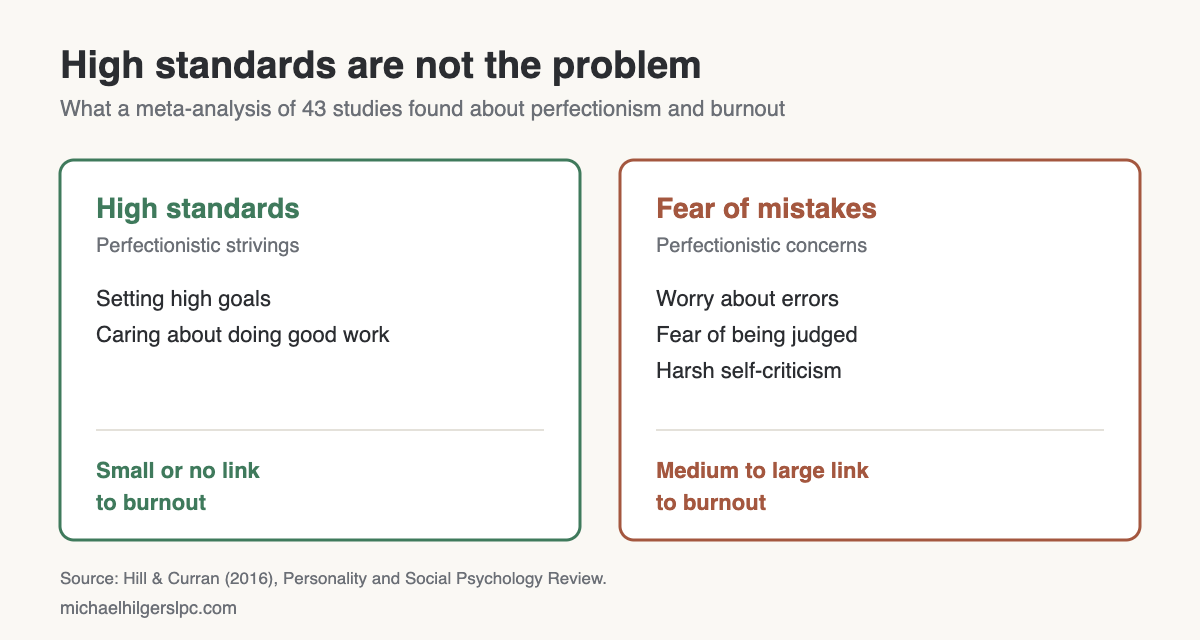
Research supports this. A meta-analysis of 43 studies separated two parts of perfectionism. Perfectionistic strivings, meaning high personal standards, had small or no links to burnout. Perfectionistic concerns, meaning fear of mistakes and of being judged, had medium to large links to burnout (Hill & Curran, 2016). A review of 67 longitudinal studies found that perfectionistic concerns predicted later increases in depressive symptoms, and depressive symptoms predicted later increases in perfectionistic concerns (Smith et al., 2021).
What changes perfectionism for attorneys
The goal is not to care less about your work. Most attorneys don’t want to become sloppy, and they shouldn’t. The research above points to the same thing: high standards aren’t the problem. The fear of mistakes is. The goal is to separate the quality of your work from your worth as a person.
Notice when it starts. Perfectionism usually kicks in right after something is finished, when you feel the urge to find one more flaw. Instead of obeying that urge automatically, look at it. What happens if you send the email now instead of rereading it a fifth time? What happens if the brief is very good instead of flawless? When people test this, the usual answer is that nothing bad happens and they get an hour back.
Look at where the belief came from. Go back to the environment that first taught you mistakes were dangerous and compare it with your adult life. You aren’t in that environment anymore. You have years of evidence that you’re good at what you do. That evidence deserves a fair hearing.
Practice “good enough” in small, low-stakes ways. Send the text without rereading it three times. Turn in the internal memo without one more pass. Let your kid win the board game without correcting their strategy. These are small, but they are practice, and the nervous system changes through repetition, not through insight alone.
Perfectionism helped get you where you are. You can learn to keep doing excellent work without it costing you this much.
Getting help with perfectionism
If you’re an attorney and this sounds familiar, you can read about my approach on the Counseling for Attorneys page or request an appointment. You may also want to read why high-performing lawyers struggle to ask for help.
Michael Hilgers, M.MFT, LPC, is a licensed therapist with a virtual private practice.
References
Hill, A. P. & Curran, T. (2016). Multidimensional perfectionism and burnout: A meta-analysis. Personality and Social Psychology Review, 20(3), 269–288. https://doi.org/10.1177/1088868315596286
Smith, M. M., Sherry, S. B., Ray, C., Hewitt, P. L. & Flett, G. L. (2021). Is perfectionism a vulnerability factor for depressive symptoms, a complication of depressive symptoms, or both? A meta-analytic test of 67 longitudinal studies. Clinical Psychology Review, 84, 101982.
