
In September 2026, Patrick Krill and Justin Anker published the first large national study of lawyer mental health in ten years (Krill & Anker, 2026). They surveyed a random sample of about 37,000 licensed attorneys in 28 jurisdictions. In that sample:
- 47.4% screened for high burnout
- 41.8% screened positive for risky drinking
- 21.7% screened for moderate to extremely severe depression
- 20.4% screened for anxiety
- 41.1% said their legal career had harmed their mental health
- 27% had considered leaving the profession
Distress was highest among younger lawyers, solo practitioners, lawyers in private firms, litigators and anyone working more than 70 hours a week.
You can read the ABA’s summary of the study on the ABA website. If so many attorneys are struggling, why do so few get help? And what can therapy for attorneys offer?
Key takeaways
- A 2026 national study of about 37,000 lawyers found that 47.4% screened for high burnout and 41.8% screened positive for risky drinking.
- Skills that help in law, like scanning for risk and staying in control, also make it harder to notice distress and ask for help.
- The most common reasons lawyers don’t use support are confidentiality concerns (53.3%) and worries about reputation or career (49.2%).
- Private-pay online therapy means there is no waiting room and no diagnosis goes to an insurance company unless you choose to submit a superbill.
The skills that make you a good lawyer
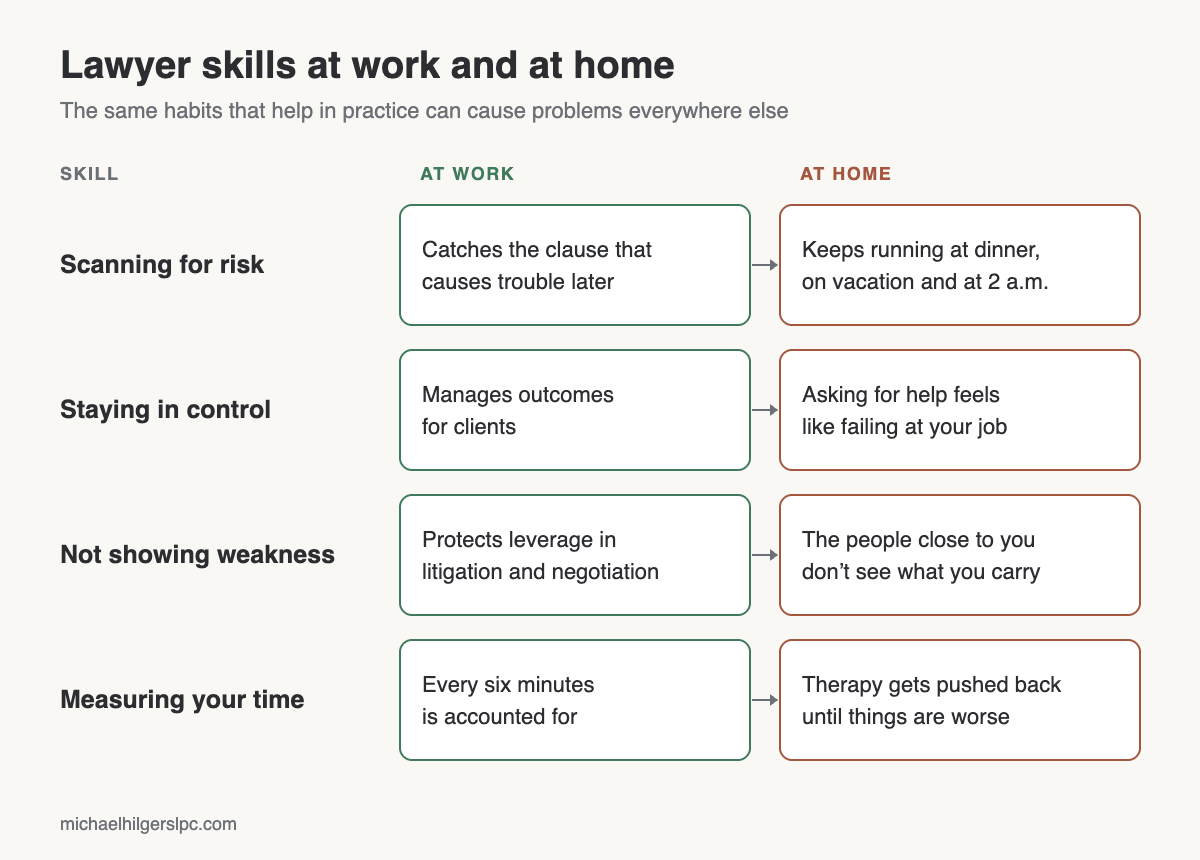
Law trains specific ways of thinking. They work in practice. They work less well when you turn them on yourself or bring them home.
You look for what could go wrong. Good lawyers anticipate risk. You read a contract for the clause that will cause trouble in three years. After enough years, that scanning doesn’t switch off. It runs during dinner, on vacation and at 2 a.m.
You stay in control. Clients pay you to manage outcomes. Asking for help means admitting something isn’t under control, and that can feel like failing at your job.
You don’t show weakness. In litigation and negotiation, showing uncertainty gives the other side leverage. Many attorneys carry that rule into their personal lives without noticing.
You measure your time. When your day is billed in six-minute units, an hour of therapy looks like an hour you can’t bill. So it gets pushed back until things are worse.
None of these are character flaws. They are job skills. They are also the habits that keep people from noticing distress early and from asking for help once they do.
Where attachment comes in
Attachment theory describes the strategies people learn early in life for handling stress and getting their needs met. Most adults lean toward one of a few patterns.
People with an avoidant style handle stress by relying on themselves. They downplay their own needs, keep emotions private and work harder when things get hard. The legal profession rewards this. Self-reliance, emotional control and long hours look like professionalism.
The cost shows up later. People who lean avoidant often don’t notice they’re overwhelmed until they’re burned out. They don’t ask for support because asking feels unsafe or unnecessary. When a partner says something is wrong, they tend to go quiet or treat the concern as a problem to solve rather than a feeling to hear. I wrote more about this in the cost of avoidance.
People with an anxious style handle stress by staying alert to other people’s approval and to any sign of rejection. In law, that can look like overpreparing, trouble setting limits with partners and clients and taking criticism from a senior attorney or judge as a verdict on your worth. Anxious attorneys often work just as many hours as avoidant ones, but because they’re afraid of disappointing people, not to prove they’re independent.
Both patterns can be changed. The first step is seeing which one you use under pressure. You can read more in What Is Avoidant Attachment?, the anxious attachment loop and on my page on anxious attachment.
What it costs at home
The skills that help at work often cause problems in relationships.
A partner who wants to talk about a hard day can end up feeling cross-examined. Arguments turn into cases to win. When your partner needs comfort, you might offer solutions or point out the flaw in their reasoning. That’s often a trained habit, not a lack of care.
Exhaustion adds to this. After a 12-hour day, many attorneys have little left for their partner or children. They pull back, and the people close to them feel it. In the 2026 study, 35.9% of lawyers reported high or very high conflict between work and personal life (Krill & Anker, 2026). An earlier study of about 2,900 lawyers found that women with high work-family conflict were 4.5 times more likely to leave or consider leaving the profession. Men with high overcommitment to work were more than twice as likely to consider leaving (Anker & Krill, 2021).
Alcohol is often part of this. The study found that 41.8% of lawyers screened for risky drinking, yet only 2.3% reported a current alcohol use disorder diagnosis. That gap suggests many attorneys drink to come down from the day without seeing it as a problem. The researchers also pointed to a workplace culture that treats heavy drinking as normal.
Why attorneys don’t ask for help
Most lawyers in the 2026 study knew about lawyer assistance programs, but many didn’t use them. The most common reasons were confidentiality concerns (53.3%) and concerns about professional reputation or career opportunities (49.2%) (Krill & Anker, 2026). Only 39.1% said their employers were doing enough to support lawyers’ mental health.
These concerns are not new. In a 2016 study of nearly 13,000 lawyers and judges, the two most common reasons for not getting help with alcohol use were not wanting others to find out (67%) and concerns about privacy or confidentiality (64%) (Krill et al., 2016).
Common barriers fall into four groups:
- Fear about licensing and reputation. Attorneys worry that therapy could come up in a bar application, a disciplinary matter or a partner review.
- Confidentiality. In a small legal community, the idea of running into a colleague in a waiting room is enough to stop some people.
- Time. Court schedules and billable hour targets leave little room for weekly appointments.
- The belief that you should be able to handle it. This is often the biggest barrier, and it connects back to the avoidant pattern above.
What therapy for attorneys can look like
I work with attorneys through a fully virtual private practice. A few details address the barriers above:
- Private pay, no insurance. I don’t bill insurance. If you want out-of-network reimbursement, I can give you a superbill to submit yourself. Otherwise no diagnosis goes to an insurance company.
- Online sessions. There’s no waiting room and no commute. Many attorneys meet from home or a private office.
- Flexible scheduling. Sessions can be planned around trial dates and filing deadlines.
The work itself is practical. We look at the patterns that show up under pressure: overwork, pulling away from your partner, the drink at the end of every day and the inability to switch off. Then we work on changing them. The goal is to keep the job from taking over the rest of your life while you stay effective at work.
If you’re not ready for therapy
Every state has a Lawyer Assistance Program (LAP) that offers confidential support to attorneys, often at no cost. Your state bar website will list yours. For substance use concerns, SAMHSA’s National Helpline is free, confidential and open 24 hours a day at 1-800-662-4357.
Next step: starting therapy for attorneys
If you’re an attorney and something here sounds familiar, you don’t have to wait for a crisis. You can learn more about my approach on the Counseling for Attorneys page, or request an appointment to set up a first conversation.
Michael Hilgers, M.MFT, LPC, is a licensed therapist with a virtual private practice.
References
Anker, J. & Krill, P. R. (2021). Stress, drink, leave: An examination of gender-specific risk factors for mental health problems and attrition among licensed attorneys. PLOS ONE, 16(5), e0250563. https://doi.org/10.1371/journal.pone.0250563
Krill, P. R. & Anker, J. J. (2026). When demands equal distress: An updated understanding of lawyer mental health and well-being. Journal of Affective Disorders. https://www.sciencedirect.com/science/article/pii/S0165032726013327
Krill, P. R., Johnson, R. & Albert, L. (2016). The prevalence of substance use and other mental health concerns among American attorneys. Journal of Addiction Medicine, 10(1), 46–52. https://doi.org/10.1097/ADM.0000000000000182
