
In 2016, the American Bar Association and the Hazelden Betty Ford Foundation published the first national study of substance use and mental health among American attorneys. Roughly 12,800 lawyers participated, and the results confirmed what many people in the profession already suspected (Krill et al., 2016).
In September 2026, the ABA released the follow-up lawyer mental health study. Patrick Krill, lead author of the 2016 study, worked with Justin Anker of the University of Minnesota Medical School to survey about 37,000 licensed lawyers across 28 jurisdictions. The results were published in the Journal of Affective Disorders under the title “When Demands Equal Distress” (Krill & Anker, 2026).
I’ve worked with high-functioning adults for decades, and lawyers are a meaningful part of my work. This is what changed, what didn’t and what it means if you practice law.
Key takeaways
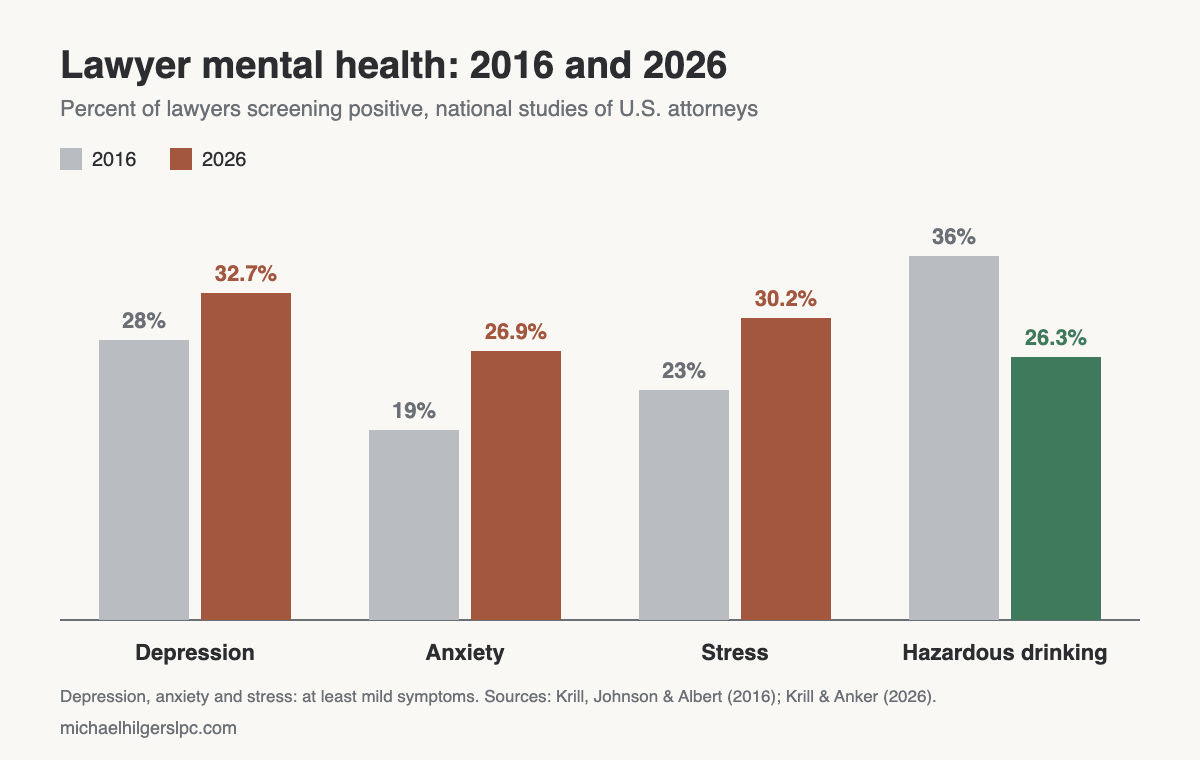
- From 2016 to 2026, at least mild depression among lawyers rose from 28% to 32.7%, anxiety from 19% to 26.9% and stress from 23% to 30.2%.
- Hazardous drinking fell about 10 percentage points to 26.3%, but 41.8% of lawyers still screened positive for risky drinking.
- In the first national measure of lawyer burnout, 47.4% screened positive for high burnout.
- Confidentiality and reputation concerns are still the main reasons lawyers don’t get help.
Where things were in 2016
The 2016 study gave the profession its first real baseline.
- About 21% of attorneys screened as problem drinkers on the full alcohol screening measure.
- 36% screened positive when researchers looked only at how much and how often lawyers drank.
- 28% reported some level of depression, 19% reported anxiety symptoms and 23% reported stress.
- Lawyers in their first ten years of practice had the highest rates of problems.
- The two biggest reasons lawyers didn’t seek help were fear of others finding out and concerns about confidentiality.
In the study’s news release, Krill said the data painted “the picture of an unsustainable professional culture.”
What the 2026 lawyer mental health study found
The new study used the same screening tool for depression, anxiety and stress, so the results can be compared. Rates of at least mild symptoms rose in all three:
- Depression rose from 28% to 32.7%.
- Anxiety rose from 19% to 26.9%.
- Stress rose from 23% to 30.2%.
For moderate to extremely severe symptoms, about one in five lawyers met the threshold in each category: 21.7% for depression, 20.4% for anxiety and 18.9% for stress.
The study also measured something the 2016 study didn’t: burnout. 47.4% of lawyers screened positive for high burnout, and 15.6% were in the severe range. This is the first national burnout benchmark for the profession.
The study also found that:
- 41.1% said practicing law has harmed their mental health.
- 27% have considered leaving the profession because of mental health, burnout or stress.
- 35.9% reported high or very high conflict between work and personal life.
- Lawyers working 71 or more hours a week had an adjusted stress rate of 42.7%, compared with 13.7% for those working 40 hours.
- Only 39.1% believe their employer is doing enough to support well-being. Only 25.3% say the same about the profession as a whole.
Younger lawyers still carry the highest risk, as they did in 2016. Solo practitioners and lawyers in private firms reported more distress than those in-house, on the bench or in academia. Litigators showed higher burnout. Men were more likely to report depression. Women reported higher anxiety and stress.
The drinking numbers are mixed
Drinking is the one area that improved. Using the same stricter threshold as 2016, hazardous drinking came in at 26.3%, about 10 percentage points lower than a decade ago. Under a broader clinical screen, 41.8% of lawyers still screened positive for risky drinking, and only 2.3% reported a current diagnosis of alcohol use disorder.
That means about four in ten lawyers screen positive for risky drinking and about two in a hundred have a diagnosis. The researchers point to barriers like licensing concerns and a workplace culture that normalizes heavy drinking. Many lawyers drink at risky levels without a diagnosis or treatment.
What hasn’t changed: the fear of being seen
In 2016, confidentiality and fear of disclosure topped the list of reasons lawyers didn’t get help. In 2026, 53.3% cited confidentiality concerns, 49.2% cited worries about their career or reputation and 34.5% said they didn’t have time. The main barrier is the same as it was ten years ago.
Lawyers are trained to anticipate risk, protect information and never show weakness to the other side. Those are professional strengths. They also make it hard to walk into a therapist’s office and say, “I’m not okay.” I wrote more about this in why high-performing lawyers struggle to ask for help.
From an attachment perspective, this makes sense. Many high achievers learned early that being competent was the safest way to stay connected. You earned your place by performing. Needing help felt risky, so you got very good at not needing it. The legal profession rewards that pattern. Over time it also wears down the person relying on it.
What changed in ten years
Awareness has grown. The numbers have not improved. The profession talks about well-being far more than it did in 2016. Bar associations have task forces. Firms have wellness programs. But the work itself (the hours, the billable pressure, the adversarial work and the constant availability) hasn’t meaningfully changed. When demands stay the same, awareness alone doesn’t move the numbers.
Drinking came down, but distress went up. That could mean some lawyers are finding healthier ways to cope. It could also mean alcohol is being replaced by other ways of numbing out, like overwork, scrolling or shutting down. The study doesn’t answer that question, but it’s one I’d want any lawyer to ask themselves.
Burnout is now measurable, and it’s widespread. Nearly half the profession screened high. Burnout isn’t a character flaw or a time-management problem. It’s what happens when sustained demand outpaces recovery for long enough.
The people most at risk are still the newest. Younger lawyers were most vulnerable in 2016 and remain so now. That suggests the way new lawyers are brought into the profession’s culture is part of the problem.
What the lawyer mental health study means for you
- Know that you aren’t alone. If 41% of your peers say this work has harmed their mental health, feeling the strain doesn’t mean you’re weak.
- Notice your coping, not just your symptoms. How much are you drinking? How much are you working? What do you reach for at 9 p.m.? Honest answers tell you a lot.
- Look at your hours. Stress rates at 71 or more hours a week were about three times the rate at 40 hours. If that’s your normal schedule, the hours are part of the problem.
- Ask how confidentiality works before you decide it’s too risky. State and local Lawyer Assistance Programs (LAPs) offer confidential support, and you can ask exactly how they handle your information before you share anything.
- Get support from someone outside the system. A private-pay therapist has no connection to your firm, your bar or your insurance company.
Working together
I work with attorneys and other high-functioning professionals who look fine from the outside but are exhausted. My practice is fully virtual and private pay. We focus on the patterns underneath the burnout: how you learned to relate to work, to needing people and to yourself.
If this study describes you, you can read about my approach on the Counseling for Attorneys page or request an appointment.
If you’re in crisis, call or text 988 (Suicide & Crisis Lifeline). For substance use support, the SAMHSA National Helpline is 1-800-662-4357.
Michael Hilgers, M.MFT, LPC, is a licensed therapist with a virtual private practice.
References
American Bar Association. (2026, September 9). New ABA/Krill Strategies lawyer mental health study shows escalating burnout, risky alcohol use. https://www.americanbar.org/news/abanews/aba-news-archives/2026/09/new-lawyer-mental-health-study/
Krill, P. R. & Anker, J. J. (2026). When demands equal distress: An updated understanding of lawyer mental health and well-being. Journal of Affective Disorders. https://www.sciencedirect.com/science/article/pii/S0165032726013327
Krill, P. R., Johnson, R. & Albert, L. (2016). The prevalence of substance use and other mental health concerns among American attorneys. Journal of Addiction Medicine, 10(1), 46–52. https://doi.org/10.1097/ADM.0000000000000182
