
I tell most couples I work with that I care less about whether they fight than about what happens in the hour after. Nearly every relationship has conflict, and conflict alone isn’t a warning sign. What predicts whether a relationship holds up is whether the two people can find their way back to each other afterward, or whether they stay distant until the next fight.
That process is called repair. Repair after conflict is one of the most important skills in a relationship, and very few people are ever taught how to do it.
Why repair matters more than the fight
Most couples assume the goal is to fight less, or to fight more calmly. Communication skills matter. But some couples rarely fight and are in serious trouble, and some fight loudly and often and are doing fine. The difference is whether both people can get back to feeling like a team afterward.
John Gottman’s research supports this. In his studies of newlywed couples at the University of Washington, failed repair attempts were one of six patterns that predicted divorce (Gottman & Silver, 1999).
Without repair, conflicts don’t resolve. They accumulate. Each unresolved fight adds to each person’s sense that the other can’t be counted on when things are hard. Over time that becomes the main feature of the relationship instead of an exception.
What repair after conflict looks like
Repair is not the same as resolution. You don’t have to settle the disagreement or agree on who was right. Repair means reconnecting and getting back the sense that you’re on the same side, even if the issue still needs more conversation later.
Gottman’s research found that about 69% of couples’ conflicts are perpetual problems that never fully get solved. Couples who stay together still have these disagreements. What differs is how they handle them.
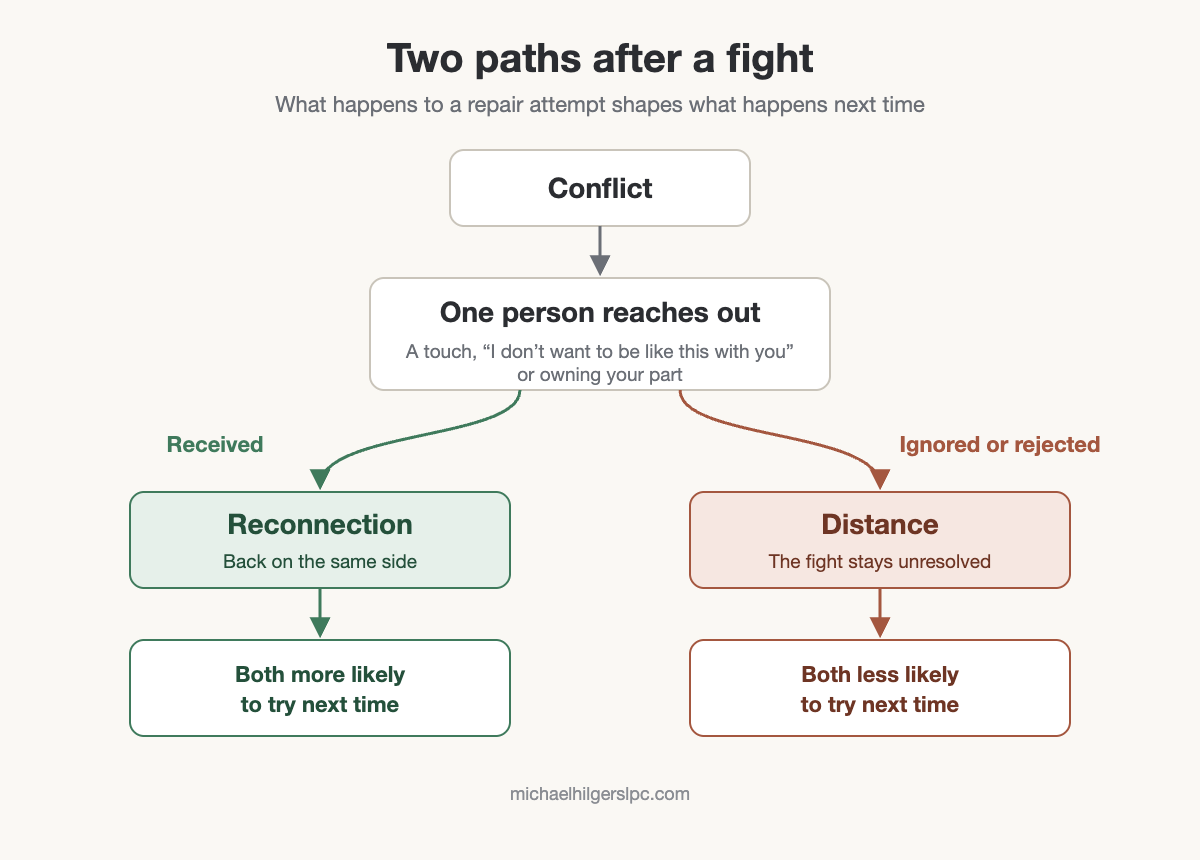
It’s usually smaller than people expect. One person reaches out first: a hand on the other person’s arm, “I don’t want to be like this with you,” or acknowledging their part in how things went, even if they still think they were right about the issue. Repair attempts are often modest and a little clumsy. What matters is that they’re offered and that they’re received.
When a repair attempt is rejected or ignored, both people learn that repair isn’t reliable in this relationship, and both become less likely to try next time. Accepting a repair attempt while you’re still upset is a skill too.
A related finding comes from a six-year study of newlyweds. Couples who were still married had responded to each other’s small bids for attention and connection 86% of the time. Couples who later divorced had responded 33% of the time (Driver & Gottman, 2004).
Why some people struggle to repair
For some people this doesn’t come naturally, and that isn’t the same as not caring. If you grew up where conflict was either explosive or never addressed, you probably never saw anyone come back together after a fight. You may know how to fight or how to avoid fighting, but you never learned the separate step of reconnecting.
For others, the obstacle is pride, or a fear of looking weak by reaching out first. Reaching out first can feel like admitting you were wrong. It isn’t. You can reach out first and still believe you were right about the argument. Treating those as the same thing is one of the most common reasons repair doesn’t happen.
Waiting for the other person to go first
A common trap is that both partners wait for the other to repair first. Each decides privately that they’ll reconnect once the other person admits what they did. One fight turns into days of distance, not because either person wants that, but because neither wants to go first. Going first has come to feel like losing.
Couples who handle this well drop that way of thinking. Reaching out first is a decision about which matters more to you: being right or staying close to your partner. When people think about it directly, most choose staying close.
How to get better at repair after a fight
Lower the bar for a repair attempt. It doesn’t have to resolve everything or perfectly express your feelings. A short, sincere gesture is enough. Make it small and make it soon. Waiting until you have the perfect apology usually means the distance lasts longer.
Practice receiving repair attempts, even when you’re still annoyed. Notice when your partner offers something, such as a joke, a touch or an acknowledgment, and meet it instead of pushing it away to make a point. This is hard, especially if you like to be completely done being upset before you reconnect. Do it anyway. The relationship’s ability to repair matters more over time than winning any single argument.
Talk about repair when you’re not fighting. Ask each other what helps you feel reconnected after a conflict. Some people need words. Some need physical affection. Some need a little time and then a return to normal without a long conversation. Knowing your partner’s answer ahead of time means you don’t have to guess when neither of you is at your best.
Every couple will disagree. What protects the relationship is that both people know how to repair afterward.
Michael Hilgers, M.MFT, LPC, is a licensed therapist with a virtual private practice.
References
Driver, J. L. & Gottman, J. M. (2004). Daily marital interactions and positive affect during marital conflict among newlywed couples. Family Process, 43(3), 301–314.
Gottman, J. M. & Silver, N. (1999). The Seven Principles for Making Marriage Work. Crown.


