
The anxious attachment loop is a common relationship pattern, and a painful one, largely because it doesn’t respond to logic the way you would expect it to.
It usually starts with something small: your partner takes longer than usual to text back, seems distracted at dinner or says “I love you” with less warmth than you’re used to hearing. Your body reacts before your mind has caught up, your chest tightens, your thoughts speed up and you feel a need to know right away that everything is okay.
So you ask, either directly (“Are we okay?”) or indirectly, by bringing up something else and watching closely for how your partner responds. Often your partner does reassure you, saying something like, “Of course I love you. I’m just tired,” and for a little while you feel better, until another small signal comes along and the cycle starts again.
The problem isn’t that you’re needy or too much, even though that may be how it feels. The problem is that reassurance is being asked to do something it can’t do.
Why the Relief Doesn’t Last
Although it feels specific to the person you’re with now, anxious attachment usually has less to do with your current partner than with a pattern that developed early in response to inconsistent caregiving, where love and attention showed up some of the time and not at other times, in ways a child could neither predict nor control. Mary Ainsworth’s research on infants and their caregivers linked this kind of inconsistent care to what she called an ambivalent pattern of attachment, an early form of what is now called anxious attachment (Ainsworth et al., 1978). Attachment theory explains why that early pattern tends to carry into adult relationships. A child in that situation doesn’t learn “I’m safe.” They learn “I have to stay alert, because the good version of this person could disappear.” That alertness becomes a baseline that doesn’t switch off just because you’ve grown up and found a stable partner.
When your partner reassures you, the words reach the part of you that asked the question, but they don’t reach the part of you that is braced for the person to leave. Words weren’t what caused the original fear and words aren’t what will resolve it. Attachment researchers Mario Mikulincer and Phillip Shaver describe this as a hyperactivating strategy: when attachment anxiety is high, the part of you that watches for threats to the relationship stays switched on, so signs of distance get noticed quickly and signs of safety don’t register for long (Mikulincer & Shaver, 2016).
That’s why you can get exactly the reassurance you asked for and still feel unsettled twenty minutes later. It isn’t that your partner said it wrong or that you need a better answer next time; it’s that no verbal answer can fully settle a fear that was never based on logic in the first place. Research on couples has found that people higher in attachment anxiety tend to seek reassurance more often, and that this pattern is associated with lower relationship satisfaction and more symptoms of depression (Shaver et al., 2005).
How It Affects Both People
The loop is hard on you, and it’s also hard on your partner. If your partner leans avoidant, the two of you can end up in a cycle in which you reach for reassurance because you’re anxious, they feel pressured and pull back for space, you notice the pullback right away, your anxiety goes up and you reach harder, which leads them to pull back further. This is often called the anxious-avoidant trap, and it’s one of the most common problematic dynamics in couples. Researchers who study couples call the same sequence the demand-withdraw pattern, and it has been linked to lower relationship satisfaction (Christensen & Heavey, 1990). Neither person is doing it on purpose; each is running their own protective pattern, and the two patterns end up feeding each other.
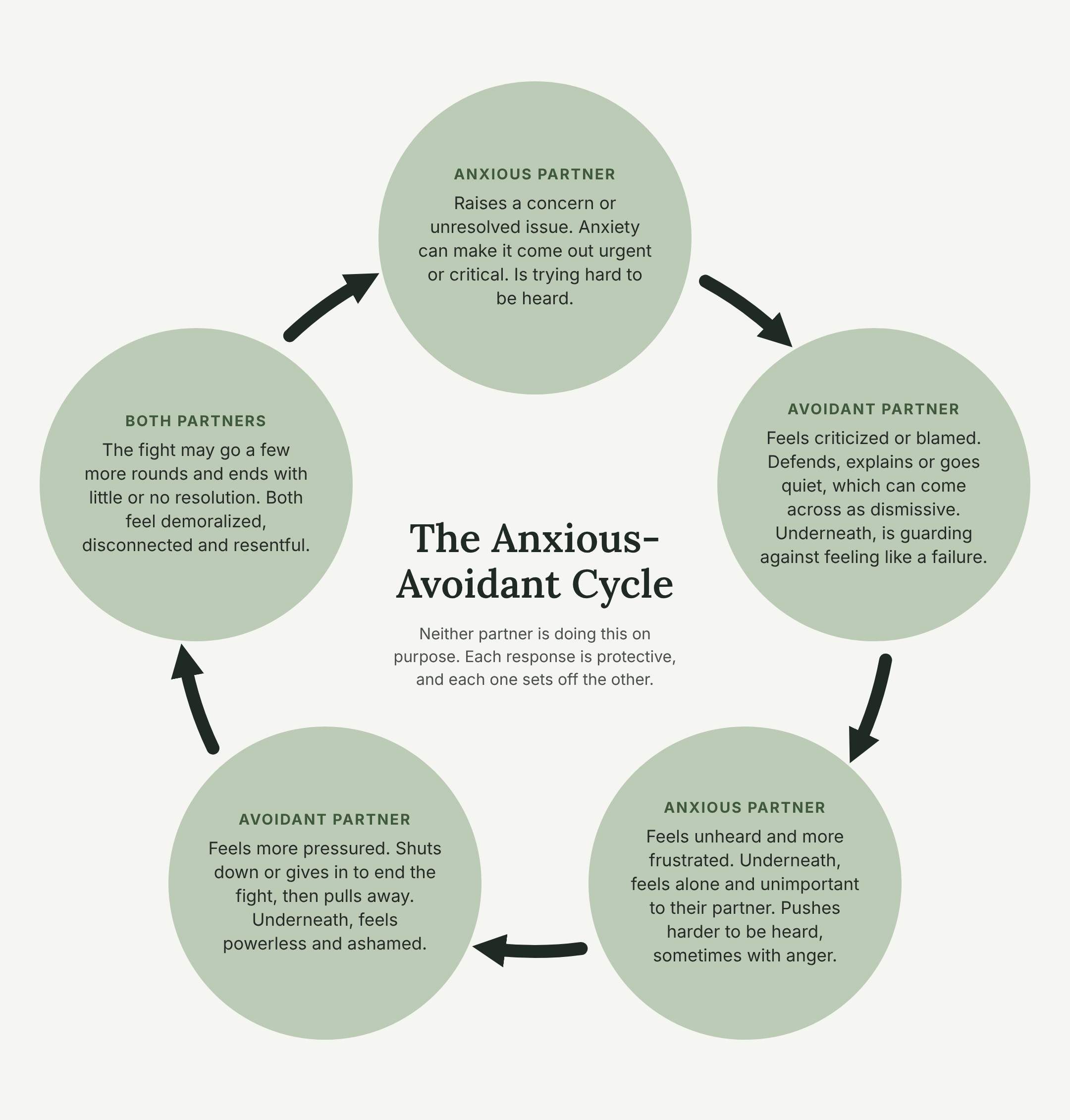
The anxious-avoidant cycle: each partner’s protective response sets off the other’s.
The loop can also show up with a partner who is secure, patient and consistent, because it comes from inside you rather than from the relationship.
What Helps
Name the pattern. You can say it to yourself (“I’m spiraling because of an old fear, and I’m reaching for reassurance to make it stop”), and you can say a version of it to your partner: “I’m feeling anxious and jumping to conclusions. I know this is an old pattern, and it may not be what’s actually happening.” Naming it lowers the intensity, because you’re describing the pattern instead of being fully inside it, and it gives your partner the context they need to respond to what’s actually going on. It also changes what you’re asking for. Instead of asking your partner to prove that nothing is wrong, which no one can do, you’re letting them know that you’re having a hard moment, which is something they can respond to with patience rather than defensiveness. If your partner understands the pattern, they’re less likely to hear your questions as an accusation, and you’re less likely to treat their answer as a test they either passed or failed.
Pause before acting on the urge. This is the slower and harder part. It doesn’t mean suppressing the anxiety; it means noticing the urge, whether that’s “I want to text again” or “I want to ask if we’re okay for the third time today,” and waiting before you act on it. While you wait, ask yourself what you’re afraid of. Usually it’s something old, such as being left, being unimportant or being forgotten, that is showing up as a worry about a text message. The pause doesn’t need to be long. Even ten or fifteen minutes gives your nervous system time to settle enough that you can tell the difference between something that needs to be addressed and something that will pass on its own. It can help to do something physical while you wait, such as taking a walk, slowing your breathing or putting your phone in another room, because the anxiety is happening in your body as much as in your thoughts. Each time you let the urge rise and fall without acting on it, you build evidence that you can tolerate the uncertainty, and over time that evidence does more for you than any single answer your partner could give.
Build steadiness outside the relationship. The loop puts your partner in charge of calming your nervous system, so it helps to have other sources of stability, including your own friendships, your routines and a sense of who you are that doesn’t depend on the relationship. This isn’t about needing your partner less or pulling away from them. It’s about making sure the relationship isn’t the only place where you feel grounded, so that when something feels off between the two of you, you have other things to stand on while you sort it out. Time with people who know you well, work that matters to you and habits that support your sleep and energy all make the anxiety easier to manage when it shows up.
Work on the original pattern in therapy. Reassurance-seeking is a symptom, and the underlying work is with the part of you that learned love was unreliable. That part changes through consistency over time, through being understood rather than just calmed down and through the repeated experience that closeness doesn’t have to disappear the way it once did. A review of studies on attachment and psychotherapy found evidence that attachment security can increase over the course of therapy (Taylor et al., 2015). In individual counseling, that often means looking at where the pattern started, noticing how it shows up in your current relationship and learning to stay with the anxious feeling long enough to understand what it’s about instead of rushing to make it go away. Couples therapy, including online therapy, can also help, particularly if you and your partner are caught in the anxious-avoidant cycle, because it gives both of you a way to see the pattern you’re in together and to respond to each other differently.
You’re not too much. You’re bringing an old fear into a new relationship, a fear that made sense at one time even if it doesn’t match your life now, and it can change, although it changes slowly.
References
Ainsworth, M. D. S., Blehar, M. C., Waters, E. & Wall, S. (1978). Patterns of Attachment: A Psychological Study of the Strange Situation. Lawrence Erlbaum Associates.
Christensen, A. & Heavey, C. L. (1990). Gender and social structure in the demand/withdraw pattern of marital conflict. Journal of Personality and Social Psychology, 59(1), 73–81.
Mikulincer, M. & Shaver, P. R. (2016). Attachment in Adulthood: Structure, Dynamics, and Change (2nd ed.). Guilford Press.
Shaver, P. R., Schachner, D. A. & Mikulincer, M. (2005). Attachment style, excessive reassurance seeking, relationship processes, and depression. Personality and Social Psychology Bulletin, 31(3), 343–359.
Taylor, P., Rietzschel, J., Danquah, A. & Berry, K. (2015). Changes in attachment representations during psychological therapy. Psychotherapy Research, 25(2), 222–238.
For books, podcasts and other tools I recommend, see my attachment style resources.